
Avery Sullivan · 17 October 2026
Harnessing Predictive Insights from User Interaction Logs in Specialized Digital Tools
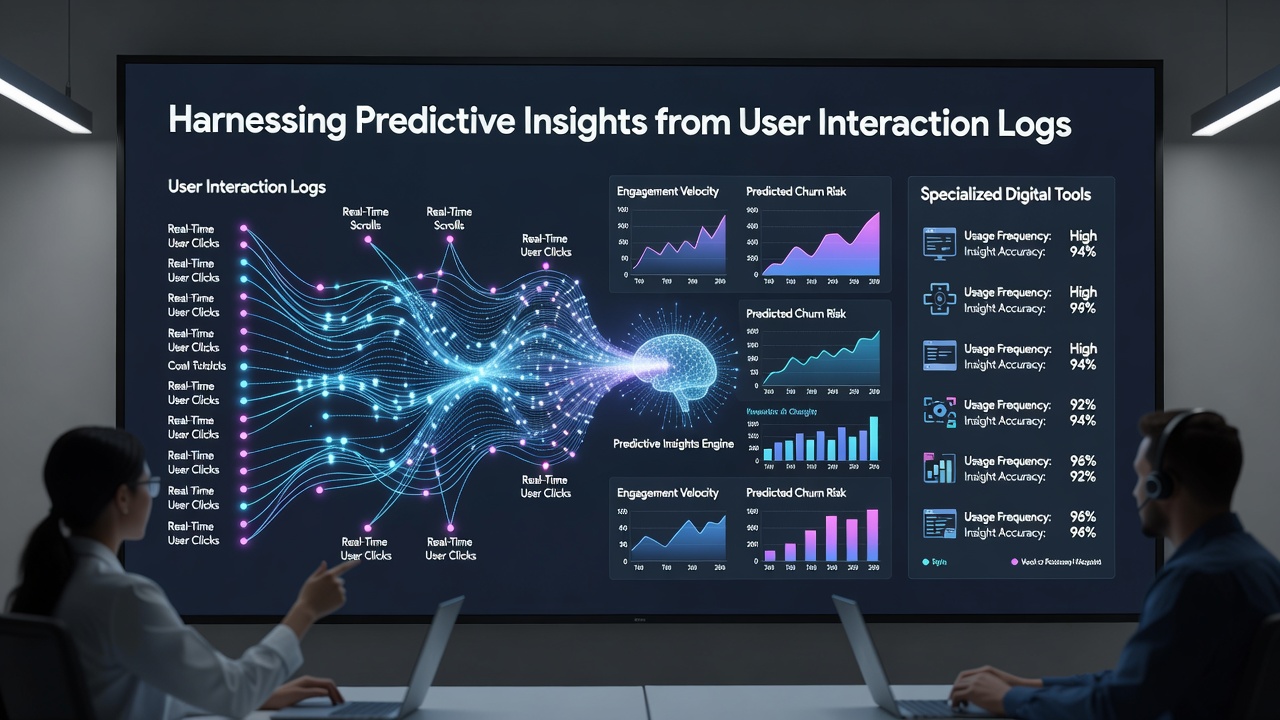
Specialized digital tools in fields such as engineering design, medical diagnostics, and educational platforms generate detailed user interaction logs that capture clicks, navigation paths, dwell times, and feature usage patterns, and these records form the foundation for predictive modeling efforts that anticipate user needs and system demands. Researchers at various institutions have documented how machine learning algorithms process these logs to forecast outcomes like task completion rates or error occurrences, with data from controlled studies showing accuracy improvements when temporal sequences receive priority in analysis pipelines. Observers note that integration of such logs with external variables, including time-of-day metrics and device specifications, enhances model robustness across multiple tool categories.
Data Collection Mechanisms in Niche Software Environments
Engineers configure logging frameworks within specialized applications to record granular events without disrupting core workflows, and this setup often involves event listeners embedded in user interface components that transmit anonymized data streams to centralized repositories. Studies conducted by academic teams in North America reveal that structured logging formats such as JSON schemas allow consistent parsing across different tool versions, while compression techniques reduce storage overhead by significant margins according to benchmarks published in computing journals. Those who maintain these systems emphasize the importance of consent protocols that align with regional data protection frameworks, ensuring logs remain usable for analytics while meeting compliance thresholds.
Predictive Modeling Techniques Applied to Interaction Sequences
Analysts apply sequence-based models including recurrent neural networks and transformer architectures to interaction logs in order to identify recurring patterns that precede specific user actions, and evidence from laboratory experiments indicates these approaches outperform simpler statistical methods when datasets exceed several million entries. In October 2026, updates to open-source libraries facilitated broader adoption of federated learning setups that train models locally on tool instances before aggregating insights, thereby limiting raw data transfers. Experts have observed that feature engineering steps, such as encoding session durations and error frequencies, directly influence prediction precision in domains like computer-aided design software where users follow complex procedural paths.
Applications Across Professional Domains
Healthcare platforms leverage interaction logs to predict clinician navigation preferences during patient record reviews, enabling interface adjustments that reduce lookup times according to pilot programs run by hospital networks in Europe and Australia. Educational tools use similar data to forecast learner disengagement points, with reports from research consortia showing proactive content recommendations that correlate with higher completion metrics. Manufacturing simulation software applies log-derived predictions to optimize rendering loads and tool suggestions, and figures released by industry associations demonstrate measurable gains in operational efficiency when these systems operate continuously. One documented case involved a CAD platform where clustering algorithms grouped user behaviors into archetypes, allowing developers to prioritize feature enhancements based on prevalence rather than anecdotal feedback.
Integration Challenges and Technical Considerations
Privacy regulations require careful handling of interaction logs because even anonymized sequences can sometimes reconstruct individual workflows, prompting organizations to adopt differential privacy methods that add calibrated noise during model training. Data quality issues arise when logs contain gaps from network interruptions or incomplete captures, and mitigation strategies documented in technical papers include imputation algorithms validated against ground-truth datasets. Scalability becomes relevant as tool user bases expand, with distributed computing frameworks recommended by guidelines from standards bodies to process high-volume streams efficiently. Those who implement these solutions report that hybrid approaches combining rule-based filters with learned components yield stable results across varying log densities.
Emerging Standards and Collaborative Efforts
International bodies have begun outlining best practices for log utilization in predictive systems, with contributions from regulatory agencies in Canada and research groups in Asia focusing on interoperability between different specialized tool ecosystems. Academic partnerships have produced shared benchmark datasets that allow comparison of prediction methods under controlled conditions, reducing duplication of effort among development teams. In practice, organizations that align their logging practices with these emerging norms gain advantages in cross-tool analytics collaborations, while maintaining traceability for audit purposes. What's interesting is how these standards evolve alongside advances in edge computing, enabling partial model inference directly on user devices to lower latency for real-time predictions.
Conclusion
Interaction logs from specialized digital tools continue to supply raw material for predictive systems that refine user experiences and operational outcomes across industries, supported by ongoing refinements in modeling techniques and data governance practices. Continued documentation from diverse geographic sources ensures these methods adapt to local requirements while advancing core capabilities. The trajectory points toward tighter integration with complementary data sources, yielding increasingly accurate forecasts that serve both tool providers and end users.